
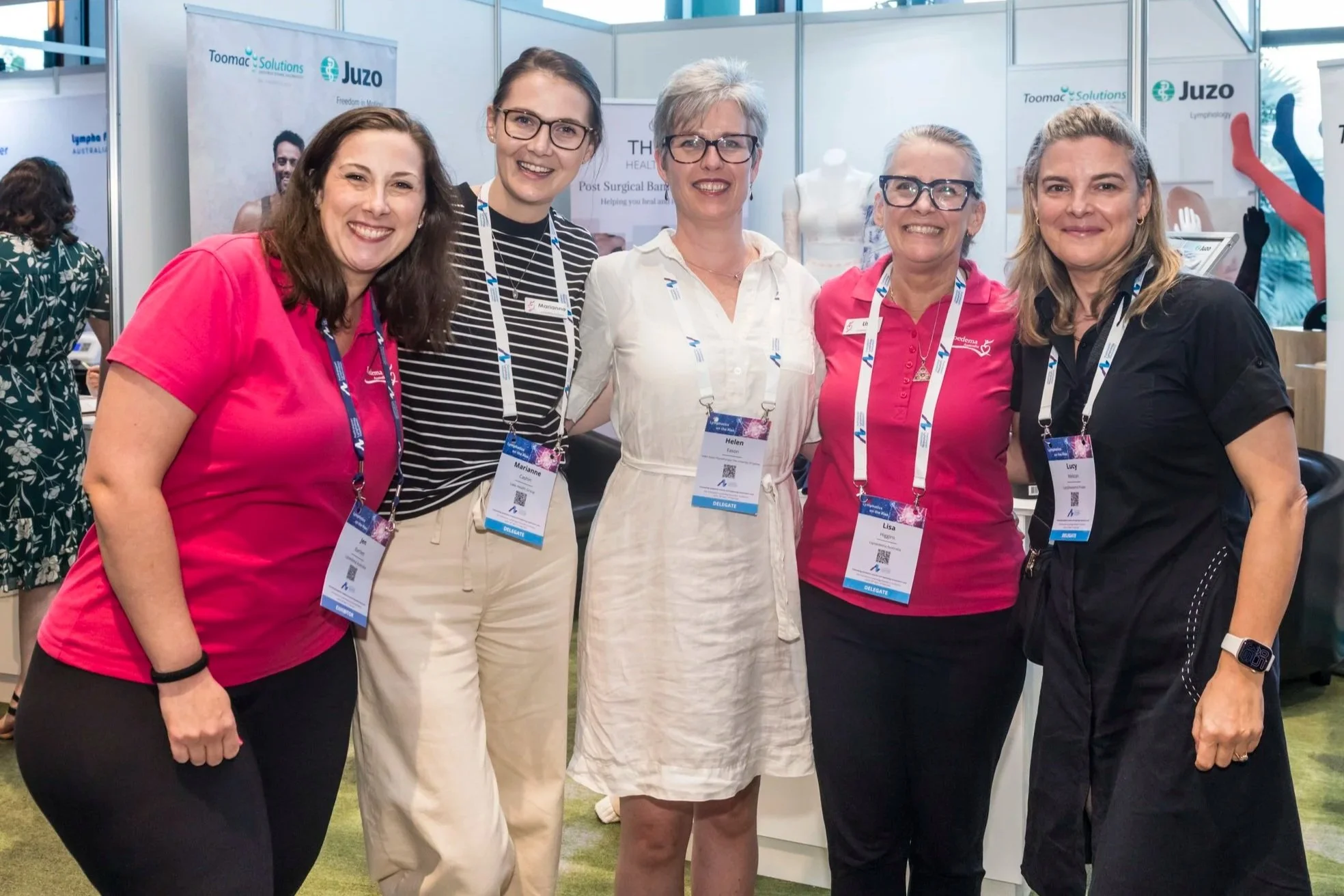
Lipoedema Australia Representatives (L-R): Board Chair, Jen Bartlett, Advisory Board Members Marianne Cashin & Helen Eason, Board Member Lisa Higgins, past Board Member Lucy Melican
Lipoedema Australia (LA) was proud to be represented at the 16th Australasian Lymphology Association (ALA) Conference, held in Cairns from Friday 1st May to Sunday 3rd May. Chair Jen Bartlett and board member Lisa Higgins attended the conference, connecting with hundreds of lymphoedema therapists, researchers, and exhibitors to further raise awareness and understanding of lipoedema.
This year’s conference highlighted the growing recognition of lipoedema within the broader lymphatic community. The momentum was further enhanced by five key presentations in the Free Paper Session dedicated to lipoedema. Jen and Lisa, along with LA Advisory Board member Helen Eason and past board member Lucy Melican, and Macquarie University ALERT Centre lecturer Dr Belinda Thompson, presented their work (or findings).
The presentations reflected both the complexity of lipoedema and the growing body of research aimed at improving care, including:
Jen Bartlett presented on “The total burden of lipoedema: How physical symptoms, care fragmentation and financial strain shape the lived experience”.
Jen’s presentation explored the significant and interconnected burdens faced by people living with lipoedema, extending well beyond physical symptoms to include emotional, financial and systemic challenges. Individuals often experience chronic pain, hypersensitivity, reduced mobility and bruising, alongside prolonged diagnostic journeys marked by confusion, conflicting advice and limited access to knowledgeable clinicians. The financial strain of ongoing care, such as compression, therapy and specialist consultations, combined with the mental load of self-advocacy, further impacts wellbeing. These challenges can contribute to worsening symptoms and delayed intervention. The presentation emphasised the need for greater awareness, more coordinated care pathways and clearer referral processes to reduce diagnostic delays and improve long-term outcomes for those living with lipoedema.
Lisa Higgins discussed “Advancing lipoedema care in Australia: Identifying practice variation and initiating national clinical dialogue”.
Lisa presented on the complexities surrounding lipoedema diagnosis and treatment, with particular emphasis on the lack of clear international consensus and the resulting variation in clinical practice. Her presentation highlighted the need for consistent, evidence-informed guidance to support remedial massage therapists in delivering appropriate care for people living with lipoedema. It also underscored the value of ongoing professional education, collaboration, and advocacy in improving awareness and outcomes across Australia.
Helen Eason presented her findings on “The reliability of tissue di-electric measurements in the lower limb”.
Helen‘s big study for her PhD thesis revolves around looking at body composition in Lipedema; fluid, fat and muscle. Before those results can be assessed, the reliability of the measurement tools that therapists use to determine fluid levels needed to be assessed. This study specifically looked at the reliability of a measurement tool called tissue dielectric constant ( trade name “lymphscanner”) to see if two different therapists gain the same result on the same woman (inter-rater reliability). The study demonstrates that the lymphscanner has moderate to substantial reliability (location dependent) with higher reliability when therapists use the average of 3 measures. Helen can now advance her big study and look at the lymph scanner results to determine whether fluid is in the skin of women with self-reported Lipedema.
Lucy Melican presented on “Waist to height ratio as an alternative measure to body mass index reduces the diagnosis of obesity in the lipoedema cohort”.
Lucy and co-author Megan Pfeffer analysed data from 151 women diagnosed with lipoedema and found that BMI classified 63.6% of patients as obese, while waist-to-height ratio (WHtR) classified only 31.7% - half as many. Unlike BMI, WHtR accounts for central adiposity and does not penalise the gynoid fat distribution typical of lipoedema. This misclassification has significant consequences for diagnosis, referrals, surgical decisions, mental health, and healthcare funding. Correcting it could redirect an estimated A$188.8 million toward lipoedema.
Belinda Thompson presented her research “Beyond body mass index: Evaluating anthropometric measures in women with lipoedema”. (Authors: Belinda Thompson, Helen Mackie, Lori Lewis, Leigh Ward)
This study highlighted the limitations of body mass index (BMI) in women with lipoedema, showing that while BMI was often higher in this group, it frequently misclassified their condition due to the disproportionate fat distribution characteristic of lipoedema. Comparing over 1,300 women, researchers found that those with lipoedema had lower waist-to-height and waist-to-hip ratios than controls, reflecting fat accumulation primarily in the lower body rather than around the abdomen. Notably, BMI misclassified nearly half of participants with lipoedema, particularly in the overweight to mildly obese range. The findings suggest that waist-to-height ratio may be a more appropriate and clinically useful measure, helping to better distinguish lipoedema from general obesity and support more accurate, individualised care.
A significant highlight was Helen Eason and Belinda Thompson receiving joint awards for best research-focused presentation. Having two lipoedema-related papers recognised at this level is an encouraging step forward in building awareness, credibility, and momentum for improved diagnosis and care.
The conference also provided valuable opportunities for face to face connection.
Jen and Lisa spent time with LA’s advisory board members Helen and Marianne, as well as former board member Lucy Melican, allowing for deeper discussions and greater clarity on key topics shaping the future of lipoedema care and advocacy.
There was consistent interest at the Lipoedema Australia stand, with a steady stream of health professionals seeking brochures and GP resources to take back to their clinics. For those unable to carry materials home, resources can be ordered directly from the Lipoedema Australia website, ensuring continued access to important educational tools.
A notable and recurring observation from therapists was the increasing number of people presenting with lipoedema in clinical practice, reported to be as high as 60%. This significant shift highlights the urgent need for education, training, and resources to support practitioners in delivering appropriate and effective care.
While ALA conferences have traditionally focused on lymphoedema research, lipoedema was strongly represented this year. This reflects what clinicians are seeing in practice and reinforces the importance of continued advocacy and education.
Lipoedema Australia remains committed to attending medical and allied health conferences to ensure that more health professionals understand lipoedema, recognise its impact, and are equipped to support those living with the condition.